
About the Authors
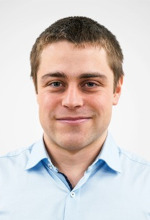
Daniel Bertschinger
At time of submission:
Institute of Theoretical Computer Science
Department of Computer Science
ETH Zurich
Zurich, Switzerland
At time of submission:
Institute of Theoretical Computer Science
Department of Computer Science
ETH Zurich
Zurich, Switzerland
Daniel Bertschinger was a researcher at ETH Zürich at the time of this project,
advised by Emo Welzl. He left the academic world and is pursuing new professional directions.
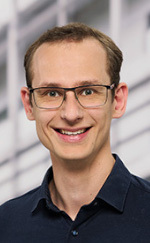
Christoph Hertrich
Tenure-track professor
Applied Discrete Mathematics
Department of Liberal Arts and Social Sciences
University of Technology Nuremberg
Nuremberg, Germany
christoph.hertrich[ta]utn[td]de
https://christophhertrich.gitlab.io/
Parts of the work were completed while Christoph Hertrich was affiliated with the London School of Economics, UK, the Goethe-Universität Frankfurt, Germany, and the Université libre de Bruxelles, Belgium.
Tenure-track professor
Applied Discrete Mathematics
Department of Liberal Arts and Social Sciences
University of Technology Nuremberg
Nuremberg, Germany
christoph.hertrich[ta]utn[td]de
https://christophhertrich.gitlab.io/
Parts of the work were completed while Christoph Hertrich was affiliated with the London School of Economics, UK, the Goethe-Universität Frankfurt, Germany, and the Université libre de Bruxelles, Belgium.
Christoph Hertrich is a tenure-track professor for Applied Discrete Mathematics at
the University of Technology Nuremberg. He is particularly enthusiastic about applying methods from polyhedral geometry, combinatorial optimization, and computational complexity to the theory of neural networks. A survey talk with some favorite problems can be found
here.
Previously, in 2023/24, he was a postdoc at
the Université libre de Bruxelles advised by
Samuel Fiorini and partially funded through
an individual Marie Skłodowska-Curie fellowship. The time in Brussels was paused when
he acted as a substitute professor for discrete mathematics at
the Goethe-Universität Frankfurt in
the winter semester 2023/24. Furthermore, in 2022/23, he was a postdoc with
László Végh at
LSE in London. He earned his Ph.D. at
TU Berlin under the supervision of
Martin Skutella (2018-22),
and his BSc and MSc at TU Kaiserslautern (now RPTU) under the
supervision of Sven O. Krumke
(2013-18). His brother Johannes works in
mathematical image processing.
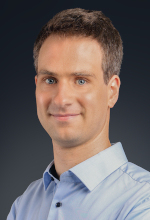
Paul Jungeblut
Institute of Theoretical Informatics
Department of Computer Science
Karlsruhe Institute of Technology
Karlsruhe, Germany
paul.jungeblut[ta]partner[td]kit[td]edu
https://i11www.iti.kit.edu/en/members/paul_jungeblut/index
Institute of Theoretical Informatics
Department of Computer Science
Karlsruhe Institute of Technology
Karlsruhe, Germany
paul.jungeblut[ta]partner[td]kit[td]edu
https://i11www.iti.kit.edu/en/members/paul_jungeblut/index
Paul Jungeblut graduated from
the Karlsruhe Institute of Technology
in 2024 under the supervision of
Torsten Ueckerdt.
His thesis was about the computational complexity of geometric problems in relation
to the first-order theory of the reals.
Since 2024, he has been working as a software engineer.
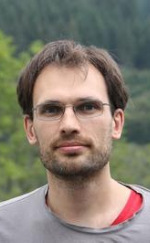
Tillmann Miltzow
Assistant professor
Department of Information and Computing Sciences
Utrecht University
Utrecht, The Netherlands
t.miltzow[ta]uu[td]nl
https://sites.google.com/view/miltzow/home
Assistant professor
Department of Information and Computing Sciences
Utrecht University
Utrecht, The Netherlands
t.miltzow[ta]uu[td]nl
https://sites.google.com/view/miltzow/home
Tillmann Miltzow is an Assistant Professor at Utrecht University. He received his
Ph.D. in Computer Science from Free University Berlin, where he was advised by Günter Rote.
His research lies in theoretical computer science, with a focus on computational geometry and
complexity theory. Much of his work studies the existential theory of the reals as a unifying
framework for understanding the complexity of geometric and combinatorial problems. A recurring
theme in his research is the interplay between discrete and continuous models of computation.
Simon Weber
At the time of submission:
Ph.D. student
Institute of Theoretical Computer Science
Department of Computer Science
ETH Zurich
Zurich, Switzerland
simon.lukas.weber[ta]alumni[td]ethz[td]ch
https://people.inf.ethz.ch/siweber/
At the time of submission:
Ph.D. student
Institute of Theoretical Computer Science
Department of Computer Science
ETH Zurich
Zurich, Switzerland
simon.lukas.weber[ta]alumni[td]ethz[td]ch
https://people.inf.ethz.ch/siweber/
Simon Weber obtained his Ph.D. at ETH Zurich under the supervision of Bernd
Gärtner (2021--25). His main research interests lay in combinatorial frameworks for optimization problems, in particular Unique Sink Orientations, but also in computational geometry, computational complexity, and topology. Since finishing his thesis, he
has been working in the cyber security industry.